Orientalism and Afong Moy
Introduction to Orientalism
Orientalism, a term coined by Edward Said, paints a picture of the West and the East as opposites; one civilized, the other a mysterious and barbaric place. Today I want to explore how Afong Moy, a Chinese woman forced to become an human exhibit in the 1800’s, exemplified the very ideals of Orientalism that Said described.
Perpetuating “Barbarism”
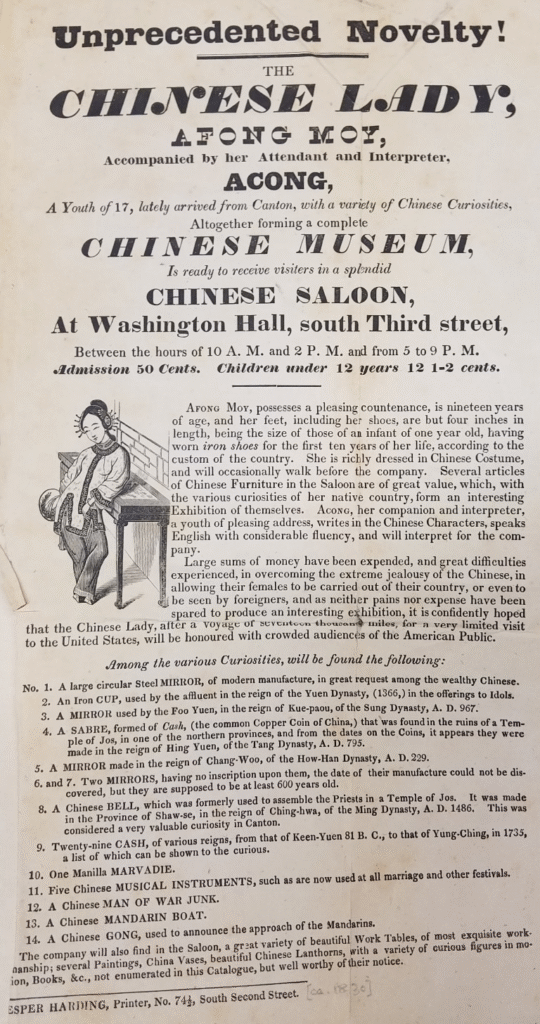
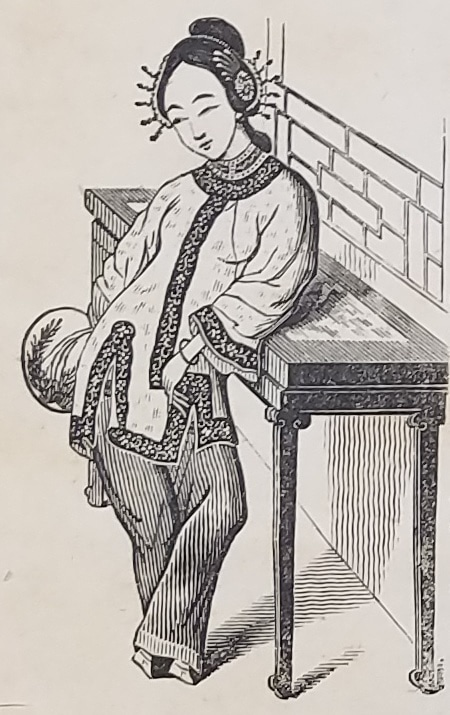
In the Parley Magazine during 1835, the unknown author comments on Afong Moy’s bandaged feet. In China, tiny, bandaged feet were seen as a symbol of beauty in women. The practice confined them to such an extent that walking became difficult. In the section titled “Manners and customs in the East,” the author criticizes such a practice, stating that “if you wish to have your body, or limbs, or lungs, or brain, become large and strong, you must not bandage or confine them, but use them” (Parley Magazine). The language that the author uses imitates a tone that a parent would use to scold their child, as if to compare these Eastern practices as innately idiotic and childlike. The author hopes that the audience can laugh at how blatantly wrong such a practice is, purposefully infantilizing Eastern “manners and cultures” to paint them as crude in comparison to the polished and refined traditions of Western society.
Yet, the author seems to ignore the equally brutal, if not worse, treatment of women in their history. One example (that is quite similar to bandaged feet) is the use of bounding corsets that permanently damaged the spines and internal organs of women for the sake of beauty. However, this comparison is made to allow audiences to feel a sense of moral superiority in comparison to the barbarism of Eastern cultures, aligning with the Orientalist lens. It was less about highlighting the truth, but more about providing more power to Western society.
Erasure of Voices
The erasure of Afong Moy’s voice in primary documents indicates how Orientalist ideals are constructed through the perspective of the conqueror. The fetishization of her as an exotic, Asian woman was filtered through both a misogynistic lens and an orientalist lens, a perspective written by white men that portrays the West as masculine and powerful, whilst the East is feminine and passive. The erasure of her own personal narratives, after all, epitomizes the Orientalist perspective, where cultures are not being personally appreciated, but turned into a caricature that portrays them as exotic and inferior. In the New York Historical Blog, one article highlights the story of Afong Moy. The author, Karintha Lowe, comments that “most of Moy’s residences no longer exist in material form, and she left behind no known personal narratives…historians know much more about how early Americans perceived the “Chinese Lady” than we do about the actual lived experiences of Moy herself.” Afong Moy was more of a persona than an actual individual in the American consciousness. The entire narrative of Moy is a purposefully constructed form of propaganda used to paint the East as the direct opposite of the West. The fact Moy’s own story lacks her own voice indicates how her narrative is exactly what represents Orientalism- the story of the East through an American perspective.
As Edward Said describes, “Orientalism, therefore, is not an airy European fantasy about the Orient but a created body of theory and practice in which, for many rations, there has been a considerable material investment” (Said, 14). Because the West is superior, and because the East is weak and barbaric, the West should be the ones that represent them. And so, Afong Moy’s story exemplifies the “investment” that Said describes, where her story is a purposeful manipulation of knowledge, devoid of her own individuality, as a tool for maintaining Western power.
Conclusion
Ultimately, Orientalism is a systemic integration of stereotypes and false narratives designed to perpetuate Western dominance. Afong Moy is a perfect embodiment of this ideal, because the objectification of her bound feet served to establish Western society as superior. The entire narrative of Afong Moy, told through newspapers and exaggerated paintings instead of her personal voice, embodies an Orientalist story told through the lens of the conqueror. The effects of Orientalism are still present in society and continue to shape how we are perceived today. But furthermore, the examples of Orientalism’s harmful effects are not only limited to Eastern cultures. We see the same things happening to African cultures and portrayals in the media to paint them as barbaric and uncivilized. These systemic stereotypes affect us all- how we view each other, and how we treat each other.
Sources:
Said, Edward W. Orientalism. Penguin Books, 200
Shanghainese
There exists a niche, sub-genre of the Chinese language spoken solely in Shanghai. Although it’s considered a declining language, I have found within it a rich and diverse community.
This summer I visited Shanghai for an internship, as well as to see family and friends. Shanghai, to me, is like a second home apart from Nanjing in China. While my mom is natively from Nanjing, my dad grew up in Shanghai. Every summer, a visit to his home is mandatory!
The two sides of my family are very different- while my mom’s side spoke purely traditional Mandarin with typical tonations, my dad spoke a mixture of “Shanghainese” and Mandarin. I never learned Shanghainese as a child, so this language was mostly used to communicate with his side of the family, or his friends and buisness partners in Shanghai.
My dad’s childhood home was almost like a different world to me, in this sense. Shanghainese is almost completely distinct from regular Mandarin. This is much different from Cantonese and Mandarin; while Canto and Mandarin had somewhat similar phrases, and a speaker of each form could mostly understand each other, Shanghainese was the complete opposite. Only being fluent in Mandarin, I could barely decipher what my dad and my grandma were saying to each other, or what him and his friends were talking about. It reminds me, once again, of the sheer diversity of Chinese culture and languages. After all, Shanghainese is only one of many small languages in China.
It turns out that despite the relatively small community of Shanghainese speakers, there are close bonds and strong friendships between those who speak it. Everytime I made a friend from Shanghai, my dad would always ask me if they could speak Shanghainese. Passing by a stranger on a road trip who could speak the language was like instant friendship. People in this community look out for each other and It was sort of like a test, to see if they embodied true Shanghai culture.
After the influx of foreigners to the city of Shanghai, the language started dying out. In the past, a big majority of people living in the city could speak Shanghainese. Now, it’s much more so a minority of people. Even more so, many Shanghainese speakers (like my dad) chose to just teach their children Mandarin, further contributing to its decline. However, there exists efforts to preserve this language and the culture behind it, like schools, lessons you can sign up for, etc.
When Does Asian American History Begin?
A few months ago, I made a post commenting on Catherine Choy’s book, Asian American Histories in the United States and its multiple starting points for considering Asian American history. Today, I want to talk about the point of these multiple starting points.
These multiple timelines serve the main purpose of highlighting stories that were otherwise understated or erased. Instead of following a singular linear textbook version of history that focuses purely on Asian presence in the States, these diverse stories and perspectives come together to form a more comprehensive picture of Asian American history. The Asian American Timeline website also emphasizes this, stating that following a linear, simplified presentation of AANHPI history “paints a misleading picture. It implies that Asian American experiences can be understood in the absence of a broader context of race and capitalism, that the history of a given population can somehow be placed outside the systems of power that organize society.” This idea also reminds me of how Asian Americans are often reduced to a single monolith. Even our history is placed within its own bubble, and our diverse community made up of different stories is tossed aside.
For example, in order to understand the large Viet presence in the States with nail salons, or Cambodian donut shops dotting various cities in the States, Choy describes how one must also understand that the influx of immigrants from Southeast Asian was because of the United States’ involvement with the Vietnam War. Because of the escalating war effort, many refugees from these countries had to flee to the States. Immigration patterns in the States were directly influenced by international wars and displacement. In search for geopolitical power, military/colonial engagements will always intersect with Asian American History. AANHPI history oftentimes cannot be fully understood without also acknowledging earlier history about such displacement that made such immigration possible.
Another point is how Asian Americans have also shaped American history through labor. The construction of the transcontinental railroad was achieved only by grueling labor from various minorities. Despite the fact that Chinese Americans completed most of the Central Pacific Railroad, their efforts were not credited and they were excluded from the railroad’s construction history. Choy’s emphasis on this storyline, as well as others, as a beginning point illustrates how AANHPI laborers played a crucial yet hidden role in American history and in changing its trajectory. Labor itself is an origin point for Asian American identity and a place where our history has been silenced.
Solidarity and “Asian American”
Where does the term “Asian American” come from?
Personally, I’ve never thought about the background of this term until my friend, and the director of Make Us Visible introduced me to its fascinating history when chatting.
I consider myself Asian American. But I hadn’t realized the true depth behind that statement, until I did further research.
The term itself developed from a movement located at Berkeley and the founding of the Asian American Political Alliance. The 1960’s marked a period where radical transformations and new ideas were brought to light to combat racism and discrimination against Asian Americans, especially as hate crimes toward our community was at an all time high. This movement also incentivized solidarity not just within the diverse Asian American population, but also with other groups like Black Americans. The term “Asian American” was then coined by Emma Gee and Yuji Ichioka as a way to defy restricting or derogatory terms used to refer to Asian Americans.
I believe that this term was not only a product of our own solidarity, but also our solidarity with other minority communities.
Black American movements toward achieving civil rights and resisting systemic discrimination have historically inspired Asian American movements. For example, Pat Sum’s visit to witness the activism of the CORE and the demonstrations against the Ku Klux Klan incentivized her own efforts in advocacy. Furthermore, the Asian American movement in the 1960s was also deeply inspired by the Black Power movement.
We are not just the model minority; we would not be where we are today without the support and influence from Black Americans, among other minorities. The very development of the term Asian American that I, and millions of others also identify themselves with, comes from fighting for our civil rights alongside other groups struggling with the same issues we faced. The prevailing consciousness between minorities should not be that of separation or isolation, but the same solidarity that allowed for impactful movements that incentivized genuine change.
Asian American History Starts in 1953
Recently, I read a book written by Catherine Choy, Asian American Histories Of the United States. Choy makes an interesting choice by organizing the history of Asian Americans from different starting points- for one, during the Delano Grape Strike of 1965, or, what I will be talking about today, the boom of mixed-race children in 1953.
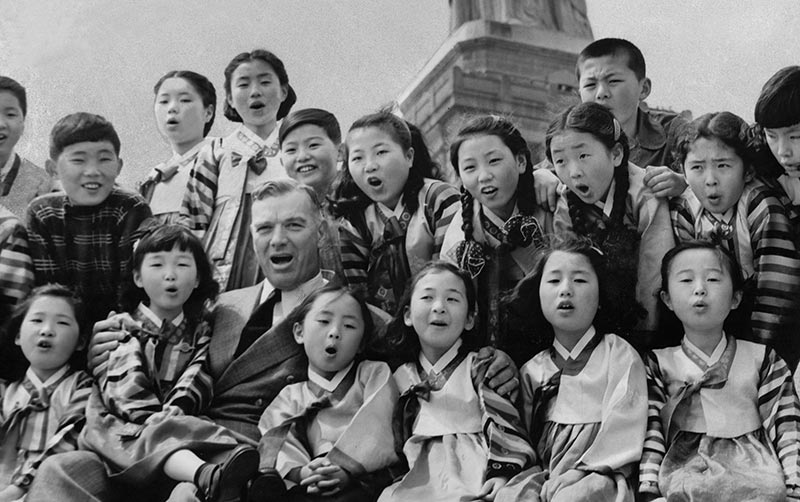
I think it’s interesting how this insurgence occurred through relations between American soldiers and Korean/Japanese women. As a starting point for Asian American history, this period is particularly interesting because it essentially is a starting point for a whole other type of Asian American experience: being biracial. In my family and many other Asian families, “mixing” is looked down upon, and people prefer to keep it within the same race. Yet for the individuals born as both White and Asian, being of such descent inevitably creates a sort of dissonance between you and your two cultures.
For me, while I am 100% Asian, my immigration to the States and my very close ties to both sides of my culture creates a similar effect. My grandparents sometimes comment on my inability to write Chinese. Although typically it’s a lighthearted poke, I sometimes mourn the ability to express myself using Mandarin in the same way I can use English. I feel like I missed out on learning how to do calligraphy in Mandarin, or reading Sun Wu Kong in its original language. In the same sense, although I’m completely fluent in English, there is always a feeling that I’m still a “foreigner” within me. Like author Choy mentioned earlier in the book, erasure of Asian American History combined with numerous other factors led to a general ignorance of Asian American culture. As a result, many of us, like myself, feel alienated from the conversation altogether regarding American history and one’s relation to this country. There is a constant gap between two sides of my identity.
Cantonese and Mandarin- Variance Between Cultures
I am fluent in Mandarin, and know little Cantonese. From a young age I could distinguish the two languages by the tone of speaking- I thought Cantonese sounded like angry temple bells, while Mandarin sounded like the firm waves of an ocean. I never thought too much about the two languages, until I actually came to the States.
Growing up in Nanjing of the Jiangsu District, I was pretty much only exposed to Mandarin. The first day of American school, My parents introduced me to another Chinese classmate who knew how to speak Chinese, hoping to help me acclimate to this new environment. When she started speaking fluent Cantonese to me, I was flummoxed, to say the least. That’s not what my language sounds like!
But the reality is that even within these two languages, there are drastic differences. Beyond the sound that each syllable made, the two languages represented different connotations, different traditions, and of course, different cultures. Mandarin only has 4 main tones, whilst Cantonese has 9, a difference that can result in completely different ways of communication!
Even within China, the Chinese language can be split distinctly. The notion that Asians can be simplified to one facet of a culture is a fundamentally flawed ideal. Learn more about Cantonese and Mandarin through these websites:
https://www.berlitz.com/blog/mandarin-vs-cantonese
https://www.verbalplanet.com/learn-chinese/blog/mandarin-chinese-versus-cantonese-chinese.asp
Let’s also not forget about the thousands of other dialects in China and Chinese culture. This medium article written by Tai Arima is insightful and highlights the diversity of the Chinese language.
https://medium.com/@taiarima/stop-asking-people-if-they-speak-mandarin-or-cantonese-c679bcbd6730
Asian Faces in Business and Beyond
Although I need to wear glasses with a particularly strong prescription (blame my genes), I don’t find myself ever confusing two different people. Especially not when they stand right in front of me, face to face. That’s why it was strange for me to be called the name of my much shorter friend of a completely different Asian ethnicity. To my face.
It was a regular day in Spanish class, and we were separated into groups to discuss “la naturaleza.” My friend and I stood side by side. My teacher, looking at my friend dead in the eyes, motioned toward for her to come closer. My friend returned after my teacher was furiously whispering to her, her mouth was twisted in a way that suggested she was holding back some laughter. She stopped in front of me, giggling about how my teacher thought that I was her and sent out an email to my parents about my alarmingly low attendance rates.
Safe to say, my parents were not happy. To make it worse, it happened more often than not especially with my teachers. There was one time where my teacher wrote someone else’s name when grading one of my essays- an astonishing feat considering there were only ten people in my English class at that time!
More than just an annoying occurrence, it felt truly wrong to be constantly mistaken for other people of the same race. It was like I wasn’t even considered an individual to other people, but an amalgamation of several Asian girls into a single, formless identity. An identity that goes by whatever name comes to mind first. This identity, forced onto me by my teachers, my peers, and even my acquaintances, was like a personal attack on my character. Even if their intentions were harmless, I felt unseen, like the bland wallpaper rather than the porcelain vase at the front of an office building.
But beyond my personal experiences, this problem does not only happen to me, a high schooler. It happens on a much larger scale, where its repercussions are much more than small. It’s extremely prevalent for Asian women in the workforce, who are often discriminated against, to be confused with other Asian women. Moreover, they are one of the least promoted minority groups into senior, executive, or managing positions, likely due to this racist factor.
To give an example, in the scientific world, properly citing names is extremely important to give credit where it’s due. Even the order of the names matters. It means that any sort of confusion between individuals could result in losing credit for all the hard work these researchers put into an experiment or paper. The fact of the matter is that the normalized racism against these Asian individuals may prevent them from reaching the proper recognition in their field that they deserve.
My friend, a senior, spoke to me the other day about just how frequently teachers confuse her submitted assignments for another Asian girls’ work, just like my past experiences. To make matters worse, this class was a difficult, all-year course on Calculus Physics. Even the name sounds daunting- and having to deal with the stress of getting the wrong grades on your hard work could only raise one’s cortisol levels.
Being mistaken for someone else over and over again isn’t just frustrating. It’s dehumanizing. What seems like a simple mix-up represents an erasure of individuality, particularly for Asian women, both in classrooms and in professional worlds. These experiences may start with something as small as a misdirected email or a mislabeled assignment, but they point to a larger pattern of racial bias that can have real consequences. At the end of the day, we all deserve to be seen for who we truly are: individuals, with unique stories and backgrounds.
The “MSG” Myth
I was told from a young age that MSG, or monosodium glutamate, is terrifically bad for your health. My mom would cook up these delicious black bean noodles and tell me all about her recipe and the way she meticulously prepared everything. But then, she would brag a little, making it clear that she didn’t use any MSG in her cooking, and it was still appetizing! She would tell me all about how MSG was toxic to your health, and dangerous to consume too often. The way my mom warned me made younger me think eating any MSG was equivalent to eating rat poison.
My family frequents Chinese restaurants often, hoping to compare it with the food back in China to see if it can live up to its legacy. Especially when I used to live in California, these visits were quite frequent. Usually eating at these places meant I was enjoying the typical, westernized Chinese food. Kung pao chicken, broccoli stir-fried beef (a dish unusually common with foreigners, my dad says), and the like.
After these meals, I would think back to what my mom and my other family members said about MSG. Is that why I feel so sluggish? So tired, and like I could fall asleep at any instant? Was it because of the MSG I consumed literal seconds ago? Was it really poisoning my nervous system and giving myself an early death?
The answer to all those questions, frankly, is no. Anna Maria Barry-Jester, in now archived website FiveThirtyEight, writes that,
People who suffer after eating MSG may be experiencing the nocebo effect, the lesser-known and poorly understood cousin of the placebo effect. The phenomenon is what happens when suggesting that something can cause a negative reaction induces precisely those physical symptoms.
In fact, the MSG myth comes from a variety of scientific research that were flawed. While MSG may still not necessarily be “good for you,” it certainly is not as poisonous as people drew it out to be. And certainly not as bad as my mom made it seem. In fact, MSG is naturally present in tomatoes! Maybe that’s why my dad’s tomato egg drop soup tastes so good.
The Consequences
The whole taboo against MSG has contributed to demonizing Chinese and other Asian restaurants for using it. The myth itself actually comes from racism when the Chinese Exclusion Act was passed in 1882. The xenophobia developed during this period extended beyond, and a “1968 letter to the New England Journal of Medicine describing sickness after eating MSG spurred an anti-MSG movement,” McKenna Princing writes in blog Right as Rain. She also names a couple racist nicknames that came from this movement, such as “Chinese restaurant syndrome.”
These implicit forms of racism is incredibly damaging to small, Chinese restaurants owners who depend on their business for money. It is harmful to propagate the idea that eating food at these restaurants will give you all sorts of short and long-term problems, when in reality much of these “facts” are derived from racism toward Chinese immigrants a century ago.
Japanese Groceries
Recently, I went on a trip with my family to Japan to visit some relatives. Spending time with family and getting a glimpse into the daily lives of people who live in Japan gave me a fresh perspective on how different our habits and lifestyles are. I noticed a lot of these differences in the small, everyday moments, but one of the most striking was something as simple as grocery shopping; almost everything was high quality and fresh, and bought in smaller portions.
The shelves were full of pristinely made desserts and snacks, that were so delicately crafted I had a hard time actually eating anything. In America, we usually buy things in bulk- and as a result we all lack that same pristiness and perfection found in Japan’s small portions. In Costco, we buy these huge packs of croissants, or these flashy boxes of different flavors of Cheetos and the like.
It is that kind of contrast I experience in Japan that showed me how different our cultures are. Across oceans and mountains, every little thing we do is different- from our shopping habits to the way our toilets function. Japanese toilets are actually super high-tech and cool, compared to the ones I’m used to in America!
This extends beyond the way we live our lives, though. What struck me most about this trip was how much these little details reflect our culturals. Our shopping habits, the technology we use, and even how we handle money all tell a story about who we are and what we prioritize. Our cultures will always be different, but these differences don’t have to divide us. We also see this in the financial habits of Japanese individuals versus American individuals, like the Japanese tendency to be less risky with money compared to Americans. These differences are not universally seen, and results in problems that arise as immigrants from different countries learn the financial system of the States. Our cultures will always be different. But it is up to us to unite and accept these differences!
Understanding Financial Diversity of Asian Businesses
When I first moved to Washington in 2018, my mom and I would frequent a small nail salon for manicures in our free time. It was a small, beautifully decorated place owned by a sweet Vietnamese couple. When I found out that this place closed a couple years later, I realized how truly hard these Asian-owned businesses were hit by the pandemic.
A particular consequence of COVID-19 was the spike in Asian hate crimes and the hit on smaller, family owned Asian businesses. The stereotype of “universal success” in Asians has lead these businesses to be unable to obtain the financial help they need.
In reality, the financial success of Asian Americans are very dependent on their personal situations- for an individual who is a recent immigrant, for example, their financial behavior and decisions are affected by the cultural and language barriers that they face when coming into the country. When it comes to ethnic groups whose languages are not as mainstream, it is much harder for them to access resources or assistance with possible financial questions and problems, especially for small business owners.
According to the Hmong Association of Washington,
Asian Americans have some of the widest variances in corporate success, education, and income.
The status of our community is unique in that our individual variances are hardly recognized for their diversity. While one ethnic group may have a large population consisted of high-status corporate positions, another may lack a college education. For one, while the Japanese has less than 5% of individuals without a high school diploma, more than 45% of the Burmese/Myanmar are without one.
Ultimately, this means that our behavior in the economic landscape of American and the opportunities we receive also vary. Without a high school diploma, entering college and getting a stable job is significantly harder.
Another example that shows the inherent distinction of Asian American financial behavior is that a large percentage of Asian Americans are also business owners, which “have been hardest hit by COVID-19” which “has exacerbated anti-Asian xenophobia and racism,” according to the Hmong Association.
These small businesses, such as your local nail salon or supermarket, have genuinely been heavily impacted by the pandemic. Even in the place where I live, many nail salons and restaurants, owned by Asian people, were forced to close down during the pandemic. The rising anti-Asian sentiments likely further led to diminishing business.
These struggles are not just a distant piece of data; in reality, it affects all the people around you and yourself. It is important for financial institutions, community organizations, and the like to recognize and address the distinct needs and challenges of the fifty plus Asian American ethnicities to promote equitable economic opportunities.