Introduction to Orientalism
Orientalism, a term coined by Edward Said, paints a picture of the West and the East as opposites; one civilized, the other a mysterious and barbaric place. Today I want to explore how Afong Moy, a Chinese woman forced to become an human exhibit in the 1800’s, exemplified the very ideals of Orientalism that Said described.
Perpetuating “Barbarism”
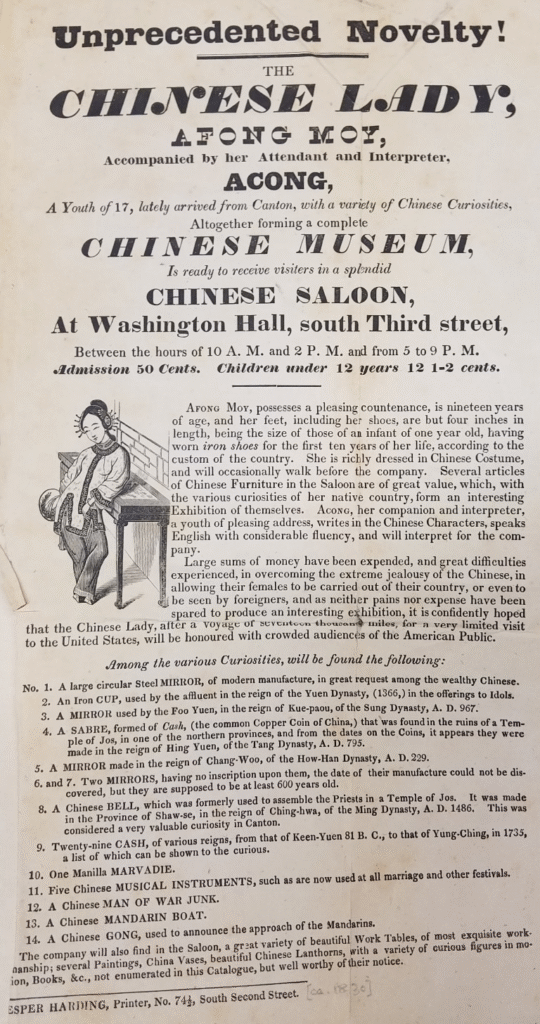
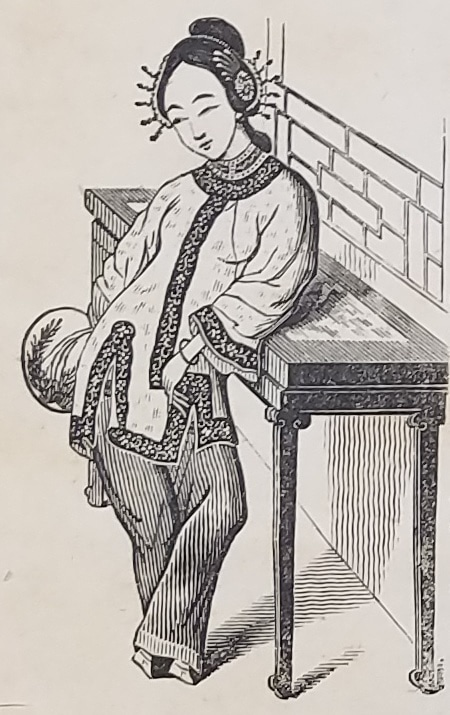
In the Parley Magazine during 1835, the unknown author comments on Afong Moy’s bandaged feet. In China, tiny, bandaged feet were seen as a symbol of beauty in women. The practice confined them to such an extent that walking became difficult. In the section titled “Manners and customs in the East,” the author criticizes such a practice, stating that “if you wish to have your body, or limbs, or lungs, or brain, become large and strong, you must not bandage or confine them, but use them” (Parley Magazine). The language that the author uses imitates a tone that a parent would use to scold their child, as if to compare these Eastern practices as innately idiotic and childlike. The author hopes that the audience can laugh at how blatantly wrong such a practice is, purposefully infantilizing Eastern “manners and cultures” to paint them as crude in comparison to the polished and refined traditions of Western society.
Yet, the author seems to ignore the equally brutal, if not worse, treatment of women in their history. One example (that is quite similar to bandaged feet) is the use of bounding corsets that permanently damaged the spines and internal organs of women for the sake of beauty. However, this comparison is made to allow audiences to feel a sense of moral superiority in comparison to the barbarism of Eastern cultures, aligning with the Orientalist lens. It was less about highlighting the truth, but more about providing more power to Western society.
Erasure of Voices
The erasure of Afong Moy’s voice in primary documents indicates how Orientalist ideals are constructed through the perspective of the conqueror. The fetishization of her as an exotic, Asian woman was filtered through both a misogynistic lens and an orientalist lens, a perspective written by white men that portrays the West as masculine and powerful, whilst the East is feminine and passive. The erasure of her own personal narratives, after all, epitomizes the Orientalist perspective, where cultures are not being personally appreciated, but turned into a caricature that portrays them as exotic and inferior. In the New York Historical Blog, one article highlights the story of Afong Moy. The author, Karintha Lowe, comments that “most of Moy’s residences no longer exist in material form, and she left behind no known personal narratives…historians know much more about how early Americans perceived the “Chinese Lady” than we do about the actual lived experiences of Moy herself.” Afong Moy was more of a persona than an actual individual in the American consciousness. The entire narrative of Moy is a purposefully constructed form of propaganda used to paint the East as the direct opposite of the West. The fact Moy’s own story lacks her own voice indicates how her narrative is exactly what represents Orientalism- the story of the East through an American perspective.
As Edward Said describes, “Orientalism, therefore, is not an airy European fantasy about the Orient but a created body of theory and practice in which, for many rations, there has been a considerable material investment” (Said, 14). Because the West is superior, and because the East is weak and barbaric, the West should be the ones that represent them. And so, Afong Moy’s story exemplifies the “investment” that Said describes, where her story is a purposeful manipulation of knowledge, devoid of her own individuality, as a tool for maintaining Western power.
Conclusion
Ultimately, Orientalism is a systemic integration of stereotypes and false narratives designed to perpetuate Western dominance. Afong Moy is a perfect embodiment of this ideal, because the objectification of her bound feet served to establish Western society as superior. The entire narrative of Afong Moy, told through newspapers and exaggerated paintings instead of her personal voice, embodies an Orientalist story told through the lens of the conqueror. The effects of Orientalism are still present in society and continue to shape how we are perceived today. But furthermore, the examples of Orientalism’s harmful effects are not only limited to Eastern cultures. We see the same things happening to African cultures and portrayals in the media to paint them as barbaric and uncivilized. These systemic stereotypes affect us all- how we view each other, and how we treat each other.
Sources:
Said, Edward W. Orientalism. Penguin Books, 200